Key Performance Indicators
Department of Environmental Conservation
Mission
Protect human health and the environment. AS 46.03.010, AS 44.46.020
Key Performance Indicators
| FY2024 Management Plan as of 04/24/2024 (in thousands) | |||||||||
| Department of Environmental Conservation Totals | Funding | Positions | |||||||
| UGF Funds | DGF Funds | Other Funds | Federal Funds | Total Funds | Full Time | Part Time | Non Perm | ||
| $21,596.0 | $22,223.6 | $20,428.7 | $45,652.8 | $109,901.1 | 546 | 0 | 9 | ||
| ||||||||||||||||||||||||||
| 2: |
Protecting the Environment
Programs include: Contaminated Sites, Industry Preparedness and Pipeline Operations, Prevention and Emergency Response, Response Fund Administration, Air Quality, and Water Quality. Contributions are also made by Administrative Services. |
Funding | Positions | ||||||
|
UGF Funds |
DGF Funds |
Other Funds |
Federal Funds |
Total Funds |
Full Time |
Part Time |
Non Perm |
||
| $7,229.2 | $15,044.2 | $10,776.7 | $18,862.2 | $51,912.2 | 266 | 0 | 6 | ||
- Target: All water facility, wastewater discharge, and air quality permit-holders are current and in compliance with permit requirements.
- Target: 50% of high risk and 20% of non-high risk contingency plan holders are inspected or evaluated for oil discharge prevention annually.
Performance Detail
| Priority 1: Protecting Human Health |
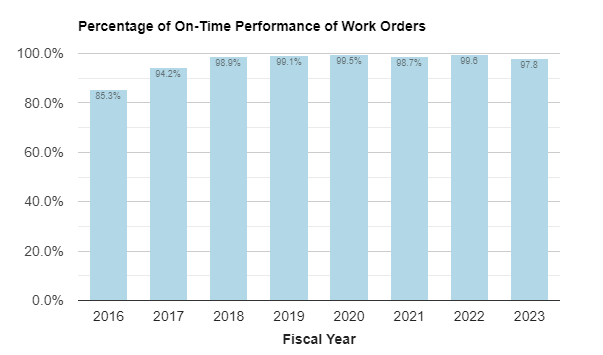
Target #2: 85% of regulated systems comply with drinking water supply system operator certification requirements..
Although the Operator Certification program oversees certification in water treatment, water distribution, wastewater treatment, and wastewater collection, this measure is limited to drinking water supply system certification as public health is most closely related to drinking water safety. This measure also excludes systems with less than 25 users or systems where users obtain water on a house-by-house basis (private wells or rain catchments), since those systems are not subject to Operator Certification requirements. The program places an emphasis on notifying systems of certification requirements, increasing the availability of exams for operators, and promoting operator training opportunities. Through these efforts, the percentage of systems employing properly certified operators has remained greater than 80% for 12 of the past 13 years. Several factors affect compliance rates, including frequent turnover of system operators, rising travel costs which inhibit operator travel to certification training, and increasing complexity of systems which drives up the certification requirements. Recognizing full compliance is unlikely given these challenges, the program has adopted 85% compliance as the target to achieve and maintain. FY2023 demonstrated a slight decline in the compliance rate from FY2022, which can be attributed to operator turnover, operators not meeting the continuing education requirement for certificate renewal, and new systems coming online without a properly certified operator. The Infrastructure Investments and Jobs Act allocated substantial increased funding the State Revolving Fund Program, a portion of which can be allocated towards assisting water systems in their efforts to attain and maintain adequate technical, financial, and managerial capacity to successfully and safely operate and maintain their systems. In addition to current efforts, the program is moving forward with initiatives that will improve outreach to systems and increase technical assistance opportunities for operators. As these new initiatives are developed and implemented, the program anticipates an increase in the number of systems with properly certified operators. Target Last Modified: 11/16/2023 |

Target #3: All rural Alaska communities are served by safe and sustainable sanitation facilities..
Since the baseline year of 2016, three unserved communities have received service and are no longer considered unserved. Additionally, 12 communities are currently funded for service, with projects in various stages of design and construction (3 are under construction with an estimated completion date in calendar years 2025-2026; the other 9 communities are in pre-design or the early stages of design, with completion dates estimated in calendar years 2027-2033). In recent years, the pace of progress had slowed as the cost of constructing centralized systems in unserved communities escalated and the substantial challenges to serving the remaining communities in terms of site conditions, capital costs, and local operational capacity. Additionally, an increasing share of total available funding has been needed in recent years to pay for necessary upgrades to existing water and sewer systems, making less funds available for constructing systems that will provide first-time service to homes. However, federal funding through the American Rescue Plan administered by the Indian Health Service (IHS) was allocated to develop comprehensive Preliminary Engineer Reports (PERs) to evaluate the various alternatives for providing piped water and sewer to the remaining unserved communities. These evaluations are meant to inform funding decisions, including the allocation of Infrastructure Investment and Jobs Act (IIJA) funds administered by IHS. Nationally, IIJA included $3.5 billion in IHS funding to address identified sanitation deficiencies, including the need for first time service in rural Alaskan communities. Several PERs were completed in SFY23, resulting in an increase in the number of communities that currently have funding for design and construction of first service project. Target Last Modified: 11/16/2023 |

Target #4: No days when air is unhealthy for sensitive groups..
The Department of Environmental Conservation has been collecting ambient air data in the most populated communities around the state for over 25 years. Air monitoring ensures compliance with the National Ambient Air Quality Standards designed to protect public health. The EPA sets health-based standards for particulate matter and gaseous pollutants. In the state, the primary pollutants of concern are particulate matter and carbon monoxide (CO). Violations of the standards occur when the concentration of air pollution particulates rise above the defined limit as a result of natural events and/or emissions from man-made sources. Natural sources of fine particulate matter (PM2.5) pollution include smoke from wildfires, while coarse particulate matter (PM10) pollution includes ash from volcanic eruption or windblown dust from gravel bars. Man-made PM2.5 pollution is often the byproduct of combustion processes, including home heating emissions such as from wood stoves, and diesel and gas vehicle emissions. Man-made PM10 pollution in Alaska is frequently produced by road dust from gravel roads and road sanding materials. The chart above shows the number of days the air quality was deemed unhealthy for sensitive groups, including children, the elderly, and people with lung or heart diseases. The increased numbers in 2012 and beyond is due to the installation of the North Pole monitoring site. In 2022, 40 exceedances occurred in the Fairbanks North Star Borough, and one each occurred in the Matanuska-Susitna Borough and, the Municipality of Anchorage. Of these exceedances 20 were man-made, due to winter-time surface inversions trapping wood smoke and industry pollution near the surface. There were 22 exceedances in 2022 caused naturally by wildland fire smoke. Since 2000, no violations of the CO standards have been recorded. The State is currently working with the Fairbanks North Star and the Matanuska Susitna Boroughs to evaluate the extent of the pollution problem and to tailor strategies aimed at eliminating the fine-particulate problem. More information about the Department"s air monitoring projects throughout the state can be found at http://www.dec.alaska.gov/air/. Related links: Target Last Modified: 11/16/2023 |

| Priority 2: Protecting the Environment |
Target #1: All water facility, wastewater discharge, and air quality permit-holders are current and in compliance with permit requirements..
For the water supply system operator certification program, which ensures operators have the qualifications necessary to meet the responsibility of safeguarding public health, a compliance rate of 80.4% was achieved in FY2023. The water discharge program issues permits for domestic wastewater, seafood processing, fish hatcheries, mines, oil and gas facilities, and log-transfer facilities. The compliance rate in FY2023 was 95%. The air quality permit program requires major and some minor stationary sources" compliance be tracked. Under federal compliance reporting, status reverts to "unknown" if compliance is not evaluated in the past two years for major sources or five years for minor sources. These sources are assumed to be in compliance for the purposes of this measure as the majority of the sources are minor sources. In FY2023, 92.7% were compliant. Target Last Modified: 11/16/2023 |

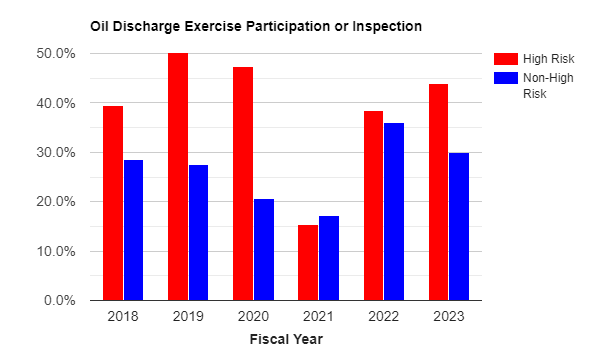
Target #2: 50% of high risk and 20% of non-high risk contingency plan holders are inspected or evaluated for oil discharge prevention annually..
The Department acknowledges all facilities or vessels required to have an ODPCP represent a level of inherent risk to the environment and public health in Alaska. For this performance measure, ODPCPs are categorized as High Risk and Non-high Risk. Facilities and vessels designated as High Risk in the state include those that are engaged in exploration, production, refinement, and transport of crude oil. All other ODPCPs are categorized as Non-high Risk. The auditing, inspecting, or testing of the Non-high-Risk facilities and their contingency plans is also important and contributes to ongoing prevention and response readiness. This performance measure tracks inspections at the ODPCP level and doesn`t capture all prevention efforts because a single ODPCP can cover multiple facilities for the same operator. Therefore, the performance measure doesn`t reflect inspections or exercises at multiple facilities under a single plan or multiple inspections at a single, complex, facility (i.e., the Trans Alaska Pipeline) during the fiscal year. During, FY2023 there were 123 ODPCPs operational in Alaska. Of these, 36 plans were classified as High Risk and 87 were classified as Non-high Risk. For High Risk ODPCPs, 44% were inspected or had an exercise and for ODPCPs classified as Non-high Risk, 30% were inspected or had an exercise during the reporting period. The Department conducted 52 inspections and 22 exercises with ODPCP holders for a total of 74 prevention measures with ODPCP holders during the reporting period; 42 were under unique ODPCPs and used in the reporting metric. Thirteen ODPCPs had more than one inspection and/or exercise at their facilities during the reporting period. Complex High Risk ODPCPs such as the Valdez Marine Terminal (n=8), North Slope Alaska Oil and Gas Exploration and Production Operations (n=7) and Hilcorp North Slope Production (n=4) had multiple inspections, and each had at least one exercise. The department routinely leveraged travel to conduct multiple facility inspections while traveling to conduct an exercise. Target Last Modified: 11/16/2023 |
Last refreshed: 04/24/2024 08:00 am